How we made WINDOW JOIN parallel and vectorized
WINDOW JOIN aggregates one table over a time window around each row of another, made parallel and vectorized, then benchmarked vs Timescale, DuckDB, ClickHouse.



Consider a workload that comes up constantly on a trading desk: for every executed trade, attach the average bid and ask within a 1-second window around the trade. Without a dedicated operator it takes two joins, an ASOF JOIN for the carry-forward quote at the window start plus a range join for the rows inside the window, stitched with UNION ALL and folded with a GROUP BY:
-- QuestDB timestamps are microseconds, so 1_000_000 is 1 second.WITH prevailing AS (-- ASOF-match against the window start (trade timestamp - 1 s),-- not the trade timestamp itself.SELECT t.orig_ts ts, t.symbol, p.bid, p.askFROM ((SELECT (timestamp - 1000000) AS ts, symbol,timestamp AS orig_tsFROM trades) TIMESTAMP(ts)) tASOF JOIN prices p ON p.sym = t.symbol),in_window AS (SELECT t.timestamp ts, t.symbol, p.bid, p.askFROM trades tJOIN prices p ON p.sym = t.symbolWHERE p.ts > t.timestamp - 1000000AND p.ts <= t.timestamp + 1000000)SELECT ts, symbol, avg(bid) avg_bid, avg(ask) avg_askFROM (SELECT * FROM prevailing UNION ALL SELECT * FROM in_window)GROUP BY ts, symbol;
This works, but it's a lot of SQL for a simple operation. The
ASOF JOIN and the range JOIN walk the prices table independently
even though they are answering two halves of the same question, and the
range JOIN forces the planner to hash on sym and then re-filter every
matched pair against the BETWEEN predicate. The outer GROUP BY over
ts is a hash aggregation that has to materialize a row per
(ts, symbol) pair, which works out to 50 million groups in our test
data. There is nothing here for the optimizer to fuse, parallelize
cleanly, or vectorize.
WINDOW JOIN is QuestDB's dedicated syntax for aggregating one table over a time window around each row of another. The same query, dedicated operator:
SELECT t.*, avg(p.bid) avg_bid, avg(p.ask) avg_askFROM trades tWINDOW JOIN prices pON p.sym = t.symbolRANGE BETWEEN 1 second PRECEDING AND 1 second FOLLOWING;
Now the operator knows what it is doing: for every row on the left-hand
side of the join (LHS - trades here), find rows on the right-hand side
(RHS - prices) whose timestamp falls inside a [lo, hi] window around
the LHS timestamp, restrict to matching symbol keys, and reduce them with
a batch of aggregate functions.
Making that fast comes down to two pieces: data-level parallelism over
the LHS, plus a low-cardinality fast path that copies values into
contiguous buffers so the SIMD aggregation kernels we already ship for
SAMPLE BY run on window slices unchanged. Benchmarked against
Timescale, DuckDB, and ClickHouse on a 50M-row trades table joined to
a 150M-row prices table, the parallel + SIMD path runs 5.0x
faster than QuestDB's own single-threaded fallback and 25x faster
than ClickHouse's best rewrite.
Data-level parallelism
QuestDB stores data in append-only column files, partitioned by time. The query engine reads them as a sequence of page frames: contiguous, columnar slabs of memory that map directly onto file pages. Filtering and aggregation both work at this granularity: a page frame is the unit of dispatch to a worker thread.
WINDOW JOIN follows the same model. The LHS table is sliced into page frames; each worker takes a frame and is responsible for producing the aggregate result for every LHS row in that frame. To do that it needs the RHS rows that fall inside the union of all windows the frame covers.
Concretely, for a frame whose LHS timestamps run from tLo to tHi with
a [-w_lo, +w_hi] window, the worker needs RHS rows in
[tLo - w_lo, tHi + w_hi]. Locating that slice cheaply is what makes the
parallel plan viable, and the enabler is QuestDB's storage layout: rows
in both tables are kept in
designated timestamp order on
disk, so the RHS slice for any time range collapses to a single binary
search per worker rather than a scan per LHS row.
Then, for the join keys present in the LHS frame, the worker builds a small in-memory index from the RHS slice: a per-key list of RHS timestamps, plus per-key arrays of the values to aggregate. Once that index is built, the inner loop over LHS rows is just two binary searches per row, one for the window's low bound and one for its high, followed by an aggregate over the resulting contiguous range. Both binary searches walk forward monotonically, so they amortize across rows in the same frame.
Roughly:
LHS page frames┌─────┬─────┬─────┬─────┬─────┐│ F0 │ F1 │ F2 │ F3 │ ... │└──┬──┴──┬──┴──┬──┴──┬──┴─────┘│ │ │ │┌──────┴┐ ┌──┴───┐ │ ││worker0│ │worker1│ ... │ workers pulled from a shared pool└───┬───┘ └──┬────┘ │ one frame at a time│ │ │┌───────┴───────┐│ ┌───────┴───────┐│ RHS slice + ││ │ RHS slice + ││ per-key ││ │ per-key ││ value arrays ││ │ value arrays │└───────┬───────┘│ └───────┬───────┘│ │ │▼ ▼ ▼┌───────────────────────────────────┐│ for each LHS row in frame: ││ bsearch lo, bsearch hi, ││ aggregate(value_array[lo:hi]) │└───────────────────────────────────┘
The reduce step is per-frame and lock-free; workers do not share any mutable state across frames. That covers the outer parallelism. The inner loop, where each LHS row aggregates its RHS slice, is where SIMD comes in.
The low-cardinality-key fast path
For low-cardinality equality joins paired with vectorizable aggregates, we copy the RHS values into per-key contiguous buffers so the SIMD kernels we already ship for SAMPLE BY can run on the window slice unchanged.
The SIMD kernels are hand-tuned sum, avg, min, max, and a few
others that munch eight doubles per loop iteration, but only on
contiguous arrays. The RHS rows in a window are not contiguous;
they are scattered across page frames, threaded through mixed columns.
Our first cut just walked the matching rows one at a time and called
computeBatch per row. Correct, but it left those kernels on the
table.
The query shape that makes the extra pass worth it is the most common
one in practice: a low-cardinality equality join (the canonical
p.sym = t.symbol case) and an aggregated numeric column. With few
distinct keys, the per-key value buffers fit in cache, and the cost of
materializing them is more than recouped by handing each window slice to
a vectorized aggregate.
The fast path is gated on two conditions: the query has to use aggregates
we have vectorized implementations for (the
sum / avg / min / max / count family over numeric types), and
the join condition has to fit the low-cardinality shape that the planner
recognizes (today, single-symbol equi-joins). When both hold, the worker
iterates its RHS slice once to build the per-key timestamp index and
copy the aggregated columns into per-key value buffers in the same pass.
The buffers are typed and packed: all bid values for symbol AAPL
land in one contiguous block of doubles, in RHS timestamp order. For
queries that don't qualify, we skip the buffer copy entirely and fall
back to the scalar computeBatch loop.
Once the inner loop reaches an LHS row, the per-key value buffer is
already laid out the way SIMD wants it. The two binary searches give us
[rowLo, rowHi) into the buffer, and we hand the slice straight to the
vectorized aggregate:
for (int i = 0; i < groupByFuncCount; i++) {groupByFunctions.getQuick(i).computeBatch(value, // running aggregate statebufferStart(i) + typeSize * rowLo, // pointer into the per-key buffer(int) (rowHi - rowLo), // slice length0);}
The extra pass over the RHS slice is not free; it reads each RHS column twice (once to put the values into the per-key buffer, once for the aggregate to consume them). For a generic plan that would be worse. But:
- The aggregate loop in QuestDB is SIMD-bound on the input if the input
is contiguous, and otherwise call-bound on
computeBatchper row. On doubles, AVX2 buys us about an order of magnitude here. - The RHS columns are read sequentially with prefetching, which is the case the memory subsystem is happiest with.
- The per-key value buffers are sized to the RHS slice for the current LHS frame, so the working set stays in L2/L3.
It took some staring at flame graphs to convince ourselves the second pass was the right call. Once we did, the fast path beat the scalar path even on small frames, and the gap widened as the LHS frame got bigger, because more LHS rows shared the same indexed buffer.
The general-predicate path still exists for queries that do not qualify
for the fast path. It runs the scalar computeBatch loop without the
buffer-copy step. EXPLAIN shows you which path your query is on:
Async Window Fast Join workers: 23vectorized: truesymbol: symbol=symwindow lo: 1000000 preceding (include prevailing)window hi: 1000000 followingPageFrameRow forward scanFrame forward scan on: tradesPageFrameRow forward scanFrame forward scan on: prices
The fast variant is Async Window Fast Join (parallel) or
Window Fast Join (serial), with vectorized: true when SIMD kernels
are engaged for your aggregates. Adding a non-vectorizable aggregate
flips vectorized: false on the same operator; switching the join key
off a symbol column falls back to Async Window Join entirely.
The SIMD (AVX2) hot loop
Once the slice is contiguous, the aggregation is the same C++ kernel that SAMPLE BY uses. Take the canonical query the operator was designed for:
SELECT t.timestamp, avg(p.bid)FROM trades tWINDOW JOIN prices pON p.sym = t.symbolRANGE BETWEEN 1 second PRECEDING AND 1 second FOLLOWING;
Once the per-key value buffer is built, the per-LHS-row work is just
avg(double) over a contiguous slice of it. avg decomposes into a sum
plus a count of non-null values (avg = sum / count, and nulls in QuestDB
are encoded as NaN), so what actually runs is a fused sum + NaN-count
kernel called sumDoubleAcc. The hot loop processes eight doubles per
iteration on AVX2:
; sumDoubleAcc, AVX2 hot loop body (rax = &d[i+8], rcx = i).Lloop:vmovupd ymm3, [rax-0xfa0] ; load d[i+4..i+7]vcmpunordpd ymm1, ymm3, ymm3 ; NaN mask, lane 1vmovupd ymm2, [rax-0xfc0] ; load d[i..i+3]vcmpunordpd ymm0, ymm2, ymm2 ; NaN mask, lane 0vpcmpgtq ymm3, ymm8, ymm1 ; widen mask, lane 1add rcx, 0x8 ; i += 8vandpd ymm1, ymm1, ymm9 ; mask & 1 (count step), lane 1add rax, 0x40 ; ptr += 8 doublesvpcmpgtq ymm2, ymm8, ymm0 ; widen mask, lane 0vandnpd ymm3, ymm3, [rax-0xfe0] ; (~mask) & d -> zero NaNs, lane 1vandnpd ymm2, ymm2, [rax-0x1000] ; (~mask) & d -> zero NaNs, lane 0vandpd ymm0, ymm0, ymm9 ; mask & 1, lane 0vpaddq ymm4, ymm4, ymm1 ; nan_count += 1 per NaN, lane 1vaddpd ymm5, ymm5, ymm3 ; sum += value, lane 1vaddpd ymm6, ymm6, ymm2 ; sum += value, lane 0vpaddq ymm7, ymm7, ymm0 ; nan_count += 1 per NaN, lane 0cmp rcx, r8jl .Lloop
Eight doubles per iteration, no branches, no scatter. Each iteration
loads two 4-double lanes, builds a NaN mask per lane, uses the mask to
zero out NaNs before adding the values into a running sum, and uses the
same mask to bump a running NaN counter. After the loop, a horizontal
reduce folds the eight lanes into a scalar sum and a scalar NaN count,
and a scalar tail handles the < 8-element remainder. The non-null
count avg needs is just the input size minus the NaN count.
For min and max the structure is identical: the same load and NaN-mask
pattern, with vminpd / vmaxpd replacing vaddpd. count is even
simpler: it's just the running NaN counter, subtracted from the input size.
Comparison with other databases
The query we benchmark wraps the WINDOW JOIN in a top-10 so every join output row has to be considered for the heap but only ten small rows go back to the client. This isolates the engine cost from the cost of streaming 50 million result rows over the wire:
SELECT ts, symbol,avg_bid, min_bid, max_bid,avg_ask, min_ask, max_askFROM (SELECT t.timestamp ts, t.symbol,avg(p.bid) avg_bid, min(p.bid) min_bid, max(p.bid) max_bid,avg(p.ask) avg_ask, min(p.ask) min_ask, max(p.ask) max_askFROM trades tWINDOW JOIN prices pON p.sym = t.symbolRANGE BETWEEN 1 second PRECEDING AND 1 second FOLLOWINGEXCLUDE PREVAILING)ORDER BY avg_bid + avg_ask DESCLIMIT 10;
Scale: 50M trades (1000 zipfian symbols) stepped over one day, against
150M prices stepped with microsecond-scale jitter over the same window.
Unlike the intro form, which defaulted to INCLUDE PREVAILING, we use
EXCLUDE PREVAILING here because INCLUDE PREVAILING would force every
rewrite on the other engines to also locate the last RHS row strictly
before the window start, adding a second lookup per trade without
changing the underlying operation. The aggregate set is also chosen for
fairness: min and max are not prefix-sum decomposable, so the other
engines cannot reach for the cumulative-diff ASOF JOIN trick that makes
the avg-only variant much cheaper to fake on engines without a
window-join operator.
Timescale, DuckDB, and ClickHouse do not have a direct WINDOW JOIN equivalent, so each one gets the most efficient rewrite we could find: a range join + GROUP BY for Timescale, and a window function over UNION ALL for DuckDB and ClickHouse. We did our best on each (idiomatic shapes, the right indexes and clustering, parallelism knobs cranked where they helped), but it is possible there is a faster shape we did not try. The full scripts are available, and per-engine query texts are in How the workload is run below. If you can get a better number out of any of these engines, we would like to hear about it.
Results
Run on a workstation: AMD Ryzen 9 7900 (12 cores / 24 threads), 64 GB
RAM, NVMe SSD, Ubuntu 24.04. Best wall time across three to five runs per
engine, in seconds. DNF rows hit the 30-minute cap; once a run hit the
cap we did not waste time on subsequent runs.
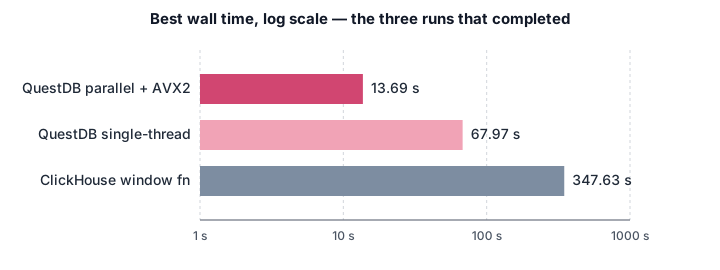
| Engine | Wall time (s) | vs QuestDB |
|---|---|---|
| QuestDB (WINDOW JOIN, parallel + SIMD) | 13.69 | 1.00x |
| QuestDB (WINDOW JOIN, single-thread + SIMD) | 67.97 | 4.96x |
| ClickHouse (window function over UNION ALL) | 347.63 | 25.4x |
| DuckDB (window function over UNION ALL) | DNF (>30 m) | n/a |
| Timescale (range join + GROUP BY, parallel) | DNF (disk) | n/a |
Reading the results
The most informative comparison is the one inside QuestDB. The parallel and
single-threaded numbers share the same plan shape, the same vectorized
inner kernel, and the same query. The only difference is whether the
data-level parallelism is engaged. So the 5.0x gap between them is a
direct measurement of what worker-pool parallelism buys us. It is not
linear in the worker count, and the reason is the outer
ORDER BY avg_bid + avg_ask DESC LIMIT 10. The Sort + Limit is serial in
both configurations, and at this scale it takes time comparable to the
parallel WINDOW JOIN phase itself: once the join phase shrinks under
parallel execution, the Sort + Limit stays put and ends up dominating a
growing fraction of the wall-clock number. With 23 worker threads, that
Amdahl ceiling is why we
see a 5.0x speedup rather than something closer to the core count: the
join scales the way you would hope, but the rest of the plan does not.
(Flipping the query to INCLUDE PREVAILING typically adds 5-10% on top
of these numbers for QuestDB, for the extra strictly-before lookup per
LHS row. The same flip is a much heavier change for the rewrite-based
plans: the prevailing price is an ASOF-style per-trade lookup that does
not fold into the window function over UNION ALL or the range
join + GROUP BY shape, so it has to be bolted on as a second pass.)
QuestDB's parallel path against the other engines closes the gap through three combined effects: a dedicated operator that knows the window structure rather than reconstructing it from a general-purpose range join, data-level parallelism over the LHS table, and handing contiguous slices to a vectorized kernel for the inner aggregate.
ClickHouse was the only other engine to complete the benchmark inside the cap, using a window function over a UNION ALL of trades and prices. A single sort + sliding-window aggregate over a unioned stream is the right plan shape for this workload, and it lands in the same order of magnitude as QuestDB's single-threaded baseline (347.63s versus 67.97s).
It is still 25x the parallel + SIMD number, though, which is where the operator-specific work in QuestDB pays off: even with the right plan shape, a general-purpose window operator over a unioned stream cannot match the data-level parallelism plus contiguous-slice SIMD that the dedicated operator gets to take for granted.
DuckDB ran the same window-function-over-UNION ALL rewrite but did not finish inside the cap. The initial parallel partitioned-sort phase used 22 cores and ~22 GB RSS comfortably under the 50 GB memory budget (no spill), but the per-partition windowed aggregate is then served by one thread per partition. With 1000 zipfian symbols and 24 cores, the long tail of large partitions can no longer keep the workers fed, and the heaviest few partitions end up serializing the tail of the query.
Timescale did not finish either. Its range join + GROUP BY rewrite gets
12-way parallelism with the planner knobs cranked, and the plan does
the right shape of work: a Parallel Index Scan into prices feeding
a Partial HashAggregate per worker. But the partial HashAggregate over
~50 million groups blows past work_mem and spills temp files past the
541 GB of free disk we had on the box, crashing the run at about six
minutes in. The root cause is the same shape as DuckDB's tail: a
general-purpose range join has to materialize every overlapping pair
before the GROUP BY can fold them, where a window-shaped join operator
would fold rows as it walks the range and never produce the
intermediate at all.
How the workload is run
Engine versions: QuestDB 9.3.5, TimescaleDB 2.26.x on PostgreSQL 17,
DuckDB 1.5.2, and ClickHouse 26.4. This is a workstation-class repro;
the scale is sized to fit in RAM on this box. The relative shape of the
results should hold on larger hardware; absolute numbers will scale with
the engine's parallel efficiency. All engines run with their default
configurations except where noted: TimescaleDB is auto-tuned by
timescaledb-tune, ClickHouse needs ORDER BY tuning on MergeTree,
and QuestDB's serial baseline needs the parallel WINDOW JOIN switch
turned off in server.conf.
The full schema definitions, data generators, and per-engine query scripts live in the benchmark repo. Each script creates the schema and loads the data if missing, then executes the query three to five times (five for QuestDB's parallel sweep, three elsewhere) and prints the best wall time.
QuestDB uses the WINDOW JOIN query shown at the start of Comparison with other databases unchanged.
TimescaleDB runs a range join + GROUP BY rewrite with all
parallelism knobs forced on (parallel_setup_cost = 0,
parallel_tuple_cost = 0, min_parallel_table_scan_size = 0,
max_parallel_workers_per_gather = 12). That plan does get a Parallel
Index Scan, but the per-worker Partial HashAggregate over ~50 M groups
blows past work_mem and spills temp files until the disk fills up:
SELECT ts, symbol,avg_bid, min_bid, max_bid,avg_ask, min_ask, max_askFROM (SELECT t.ts, t.symbol,avg(p.bid) AS avg_bid, min(p.bid) AS min_bid, max(p.bid) AS max_bid,avg(p.ask) AS avg_ask, min(p.ask) AS min_ask, max(p.ask) AS max_askFROM trades tLEFT JOIN prices pON p.sym = t.symbolAND p.ts >= t.ts - INTERVAL '1 second'AND p.ts <= t.ts + INTERVAL '1 second'GROUP BY t.ts, t.symbol) subORDER BY (avg_bid + avg_ask) DESCLIMIT 10;
A lateral-subquery shape against a (sym, ts DESC) index on prices
looks more idiomatic on a hypertable, but it relies on PostgreSQL's
lateral nested loop, which is single-threaded by design. At parity scale
it ran an order of magnitude slower than the range join + parallel hash
aggregate plan, so we dropped it for the full run.
For DuckDB the closest structural analog to a window join is a
window function over a UNION ALL that tags trades and prices into a
single stream, runs the windowed avg / min / max of bid and
ask partitioned by sym and ordered by ts, and keeps only the trade
rows. Trade rows carry NULL bid/ask in the stream, so when no
in-window price exists the windowed aggregates over NULLs evaluate to
NULL, matching QuestDB's EXCLUDE PREVAILING output. DuckDB accepts
INTERVAL range offsets natively, so no microsecond cast is needed:
WITH stream AS (SELECT ts, sym, bid, ask, FALSE AS is_trade FROM pricesUNION ALLSELECT ts, symbol AS sym, NULL::DOUBLE AS bid, NULL::DOUBLE AS ask, TRUE FROM trades)SELECT ts, symbol,avg_bid, min_bid, max_bid,avg_ask, min_ask, max_askFROM (SELECT ts, sym AS symbol, is_trade,avg(bid) OVER w AS avg_bid,min(bid) OVER w AS min_bid,max(bid) OVER w AS max_bid,avg(ask) OVER w AS avg_ask,min(ask) OVER w AS min_ask,max(ask) OVER w AS max_askFROM streamWINDOW w AS (PARTITION BY symORDER BY tsRANGE BETWEEN INTERVAL 1 SECOND PRECEDING AND INTERVAL 1 SECOND FOLLOWING)) subWHERE is_tradeORDER BY (avg_bid + avg_ask) DESCLIMIT 10;
ClickHouse runs the same window-function-over-UNION ALL shape as
the DuckDB rewrite. The MergeTree ORDER BY (sym, ts) clustering on
both tables is essential here so the per-partition sort and windowed
aggregate can stream linearly. ClickHouse window functions require
numeric range offsets, so timestamps are pre-converted to microseconds:
WITH stream AS (SELECT toUnixTimestamp64Micro(ts) AS ts_us, sym, bid, ask, 0 AS is_tradeFROM pricesUNION ALLSELECT toUnixTimestamp64Micro(ts) AS ts_us, symbol AS sym,CAST(NULL AS Nullable(Float64)) AS bid,CAST(NULL AS Nullable(Float64)) AS ask,1 AS is_tradeFROM trades)SELECT ts_us, symbol,avg_bid, min_bid, max_bid,avg_ask, min_ask, max_askFROM (SELECT ts_us, sym AS symbol, is_trade,avg(bid) OVER w AS avg_bid,min(bid) OVER w AS min_bid,max(bid) OVER w AS max_bid,avg(ask) OVER w AS avg_ask,min(ask) OVER w AS min_ask,max(ask) OVER w AS max_askFROM streamWINDOW w AS (PARTITION BY symORDER BY ts_usRANGE BETWEEN 1000000 PRECEDING AND 1000000 FOLLOWING))WHERE is_trade = 1ORDER BY (avg_bid + avg_ask) DESCLIMIT 10;
More WINDOW JOIN use cases
The trades-and-quotes pattern is the canonical example, but the operator handles other shapes too:
- Window bounds can be constants, LHS columns, or expressions.
- One-sided windows (PRECEDING AND PRECEDING, FOLLOWING AND FOLLOWING) are supported.
- INCLUDE PREVAILING / EXCLUDE PREVAILING controls whether the carry-forward quote (the most recent RHS row at or before the window start) fills the start of the window when no in-window row already covers it.
- Supported aggregates are
sum,avg,count,min,max,first,last,first_not_null,last_not_null.
A one-sided example, anchoring a trade count to news arrivals:
SELECT n.ts, n.headline, count(*) trades_5mFROM news nWINDOW JOIN trades tON t.symbol = n.symbolRANGE BETWEEN 0 FOLLOWING AND 5 minutes FOLLOWINGEXCLUDE PREVAILING;
For more market-data patterns, see our Capital Markets Recipes.
What's next?
This is one piece of a broader effort to make temporal operators first-class in QuestDB. WINDOW JOIN was the obvious next step after ASOF JOIN; HORIZON JOIN, which gives you P&L-style markouts at multiple fixed horizons after every event, is already in 9.3.5, and the next post in this series will be on how we built and optimized it.
For the full grammar and a longer list of examples, see the documentation page. And if you have a window-shaped query that does not fit the patterns above, we would love to hear about it.
As usual, we encourage you to try the latest QuestDB release and share your feedback on our Community Forum. You can also play with our live demo to see how fast it executes your queries.