TimescaleDB vs QuestDB: 2026 Benchmark Results
Compare QuestDB and TimescaleDB with up-to-date performance benchmarks and architectural comparisons.



Choosing the right database is a careful exercise. We feel the best way to help you cut through the marketing noise is to provide the most rigorous benchmarks available, and then to put the results in context.
TimescaleDB and QuestDB are two popular open-source time-series databases. TimescaleDB positions itself as an enhanced PostgreSQL for faster analytics, while QuestDB is purpose-built for raw performance, low latency, and high throughput.
To that end, this article contains a deep performance comparison of TimescaleDB and QuestDB.
These benchmarks predate QWP, the binary protocol we shipped in QuestDB 10.0 in August 2026. Ingestion here runs over InfluxDB Line Protocol, a text format the server parses row by row. QWP sends binary columns instead, about 3.6x faster over a network, and it streams reads back as Arrow. Read the QuestDB figures below as a floor.
Introducing TimescaleDB & QuestDB
Both Timescale & QuestDB aim to help developers scale time series workloads.
According to DB-Engines, the two break down as such:
| Feature | QuestDB | TimescaleDB |
|---|---|---|
| Primary database model | Time Series DBMS | Time Series DBMS |
| Implementation language | Java (zero-GC), C++, Rust | C |
| SQL? | Yes | Yes |
| APIs | ILP, HTTP, PGWire, JDBC | JDBC, ODBC, C lib |
TimescaleDB is a time series database built atop PostgreSQL. It's provided under two licenses: Apache 2.0 and the proprietary Timescale License. It's an extension of PostgreSQL, rather than a standalone database. For many in the PostgreSQL ecosystem, it provides a familiar entry point into time series workloads while retaining full PostgreSQL compatibility.
Want to see a QuestDB comparison vs. InfluxDB? Read the article
On the other side, QuestDB is an open-source time series database licensed under Apache License 2.0. It's built from the ground up for maximum performance and ease-of-use, and has been tempered against the highest throughput, highest cardinality ingestion cases. It's also built atop open formats such as Parquet to avoid vendor lock-in. QuestDB offers very fast querying, accessible via SQL-based extensions.
Performance benchmarks
Before we get into internals, let's compare how QuestDB and TimescaleDB handle both ingestion and querying. As usual, we use the industry standard Time Series Benchmark Suite (TSBS) as the benchmark tool.
Ingestion benchmark results
Starting with ingestion, how do the two compare?
The hardware used is the following:
-
AWS EC2 r8a.8xlarge instance with 32 vCPU and 256 GB RAM (AMD EPYC)
-
GP3 EBS storage configured for 20,000 IOPS and 1 GB/s throughput
And on the software side:
-
Ubuntu 22.04
-
TimescaleDB 2.23.1 on PostgreSQL 17.6
-
QuestDB 9.2.2 with the out-of-the-box configuration
The benchmark compares ingestion speed between QuestDB and TimescaleDB using the TSBS cpu-only use case. Data is sent via 32 concurrent connections. We test three scale factors representing different cardinality levels:
↑ Higher is better
QuestDB faster than TimescaleDB
QuestDB rows/sec peak
| Scale (hosts) | Rows | QuestDB (rows/sec) | TimescaleDB (rows/sec) | QuestDB Advantage |
|---|---|---|---|---|
| 100 | 1,728,000 | 4,023,402 | 313,113 | 12.9x faster |
| 1,000 | 17,280,000 | 7,483,735 | 1,244,709 | 6.0x faster |
| 4,000 | 69,120,000 | 9,532,172 | 1,177,506 | 8.1x faster |
| 100,000 | 172,800,000 | 11,360,000 | 1,034,797 | 11.0x faster |
| 1,000,000 | 576,000,000 | 7,330,000 | 620,267 | 11.8x faster |
QuestDB starts at 4 million rows per second and scales up to 11.4 million rows per second at 100K hosts. This demonstrates QuestDB's ability to maintain and even improve throughput as data volume increases.
On the other hand, TimescaleDB's performance peaks at around 1.2 million rows per second for 1,000 hosts, then degrades at higher cardinality—dropping to 620K rows/sec at 1M hosts.
In most benchmarks in the time series space, high cardinality data is where performance profiles start to really diverge. QuestDB's ingestion rate is up to 13x superior to TimescaleDB across all tested cardinality levels.
It should be noted that TimescaleDB's performance characteristics are influenced by PostgreSQL's row-based architecture, which presents challenges when scaling time-series data workloads.
Query benchmark results
As part of the standard TSBS benchmark, we test several types of popular time series queries. These include single-groupby queries (aggregating metrics for specific hosts over time ranges), double-groupby queries (aggregating across all hosts), and heavy analytical queries.
All query benchmarks run with a single worker against the 4,000-host dataset (69 million rows).
Single-Groupby Queries
These queries aggregate CPU metrics for random hosts over specified time ranges.
↓ Lower is better
Query format: metrics-hosts-hours · averaged over 10 runs
QuestDB faster on complex queries
tied on simple point queries
| Query | QuestDB (mean) | TimescaleDB (mean) | QuestDB Advantage |
|---|---|---|---|
| 1 metric, 1 host, 1h | 1.07 ms | 1.07 ms | Similar |
| 1 metric, 1 host, 12h | 1.73 ms | 5.49 ms | 3.2x faster |
| 1 metric, 8 hosts, 1h | 1.47 ms | 3.62 ms | 2.5x faster |
| 5 metrics, 1 host, 1h | 1.01 ms | 1.15 ms | Similar |
| 5 metrics, 1 host, 12h | 1.84 ms | 5.58 ms | 3.0x faster |
| 5 metrics, 8 hosts, 1h | 1.47 ms | 3.67 ms | 2.5x faster |
For simple point queries, both databases perform similarly. However, as query complexity increases (longer time ranges, more hosts), QuestDB's advantage becomes clear with up to 3.2x better performance.
Double-Groupby Queries
These queries aggregate across ALL 4,000 hosts, grouped by host and 1-hour intervals - a common analytical workload.
↓ Lower is better
Aggregates across ALL 4,000 hosts, grouped by host and 1-hour intervals · averaged over 100 runs
QuestDB faster than TimescaleDB
QuestDB latency
TimescaleDB latency
| Query | QuestDB (mean) | TimescaleDB (mean) | QuestDB Advantage |
|---|---|---|---|
| 1 metric, all hosts | 33.84 ms | 547 ms | 16x faster |
| 5 metrics, all hosts | 43.59 ms | 789 ms | 18x faster |
| 10 metrics, all hosts | 56.80 ms | 1,135 ms | 20x faster |
For double-groupby queries, QuestDB is up to 20x faster than TimescaleDB, showcasing its strength in analytical workloads with multiple aggregations.
Heavy Analytical Queries
The high-cpu-all query performs a full table scan finding hosts with CPU
utilization above a threshold.
high-cpu-all query latency · ↓ Lower is better
Full table scan finding hosts with CPU utilization above threshold · averaged over 10 runs
QuestDB faster on high-cpu-all
QuestDB latency
TimescaleDB latency
| Query | QuestDB (mean) | TimescaleDB (mean) | QuestDB Advantage |
|---|---|---|---|
| high-cpu-all | 979 ms | 1,082 ms | 1.1x faster |
For heavy analytical queries scanning large portions of the dataset, both databases perform comparably, with QuestDB maintaining a slight edge.
"OLAP" query benchmarks
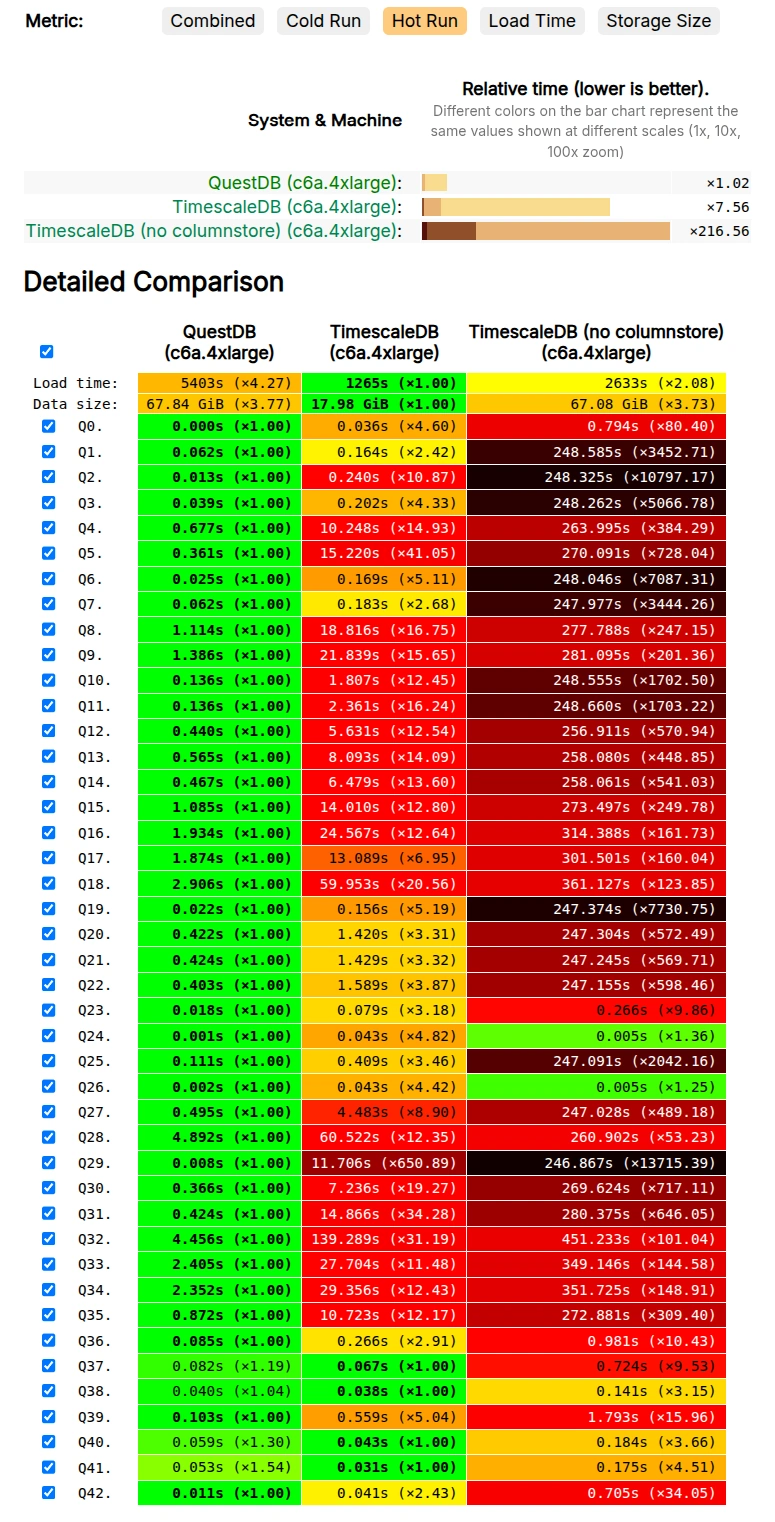
Although time series databases are optimized for time-based queries, established "Online Analytical Processing (OLAP)" benchmarks cast a net wider. One of such well-known benchmarks is the ClickBench benchmark.
Across most queries, QuestDB outperforms Timescale by up to 650x on the same c6a.4xlarge AWS EC2 instance type:
Architecture overview
The results tell a story.
But what's under the hood that leads to these outcomes?
TimescaleDB overview
TimescaleDB extends PostgreSQL's row-based architecture with a hybrid row-columnar storage engine called Hypercore. Recent data is stored in row format for fast inserts, while older data is automatically converted to columnar format with compression. This contrasts with the purely columnar architectures of DuckDB, InfluxDB 3.0, and QuestDB, which store all data in columnar format from the start.
It leverages SQL's capabilities, including joins, secondary and partial indexes, and integrates with other extensions like PostGIS, enhancing PostgreSQL's performance for time series data. However, its performance comparisons are relative to PostgreSQL rather than specialized time series databases. As such, TimescaleDB's PostgreSQL compatibility is a double-edged sword.
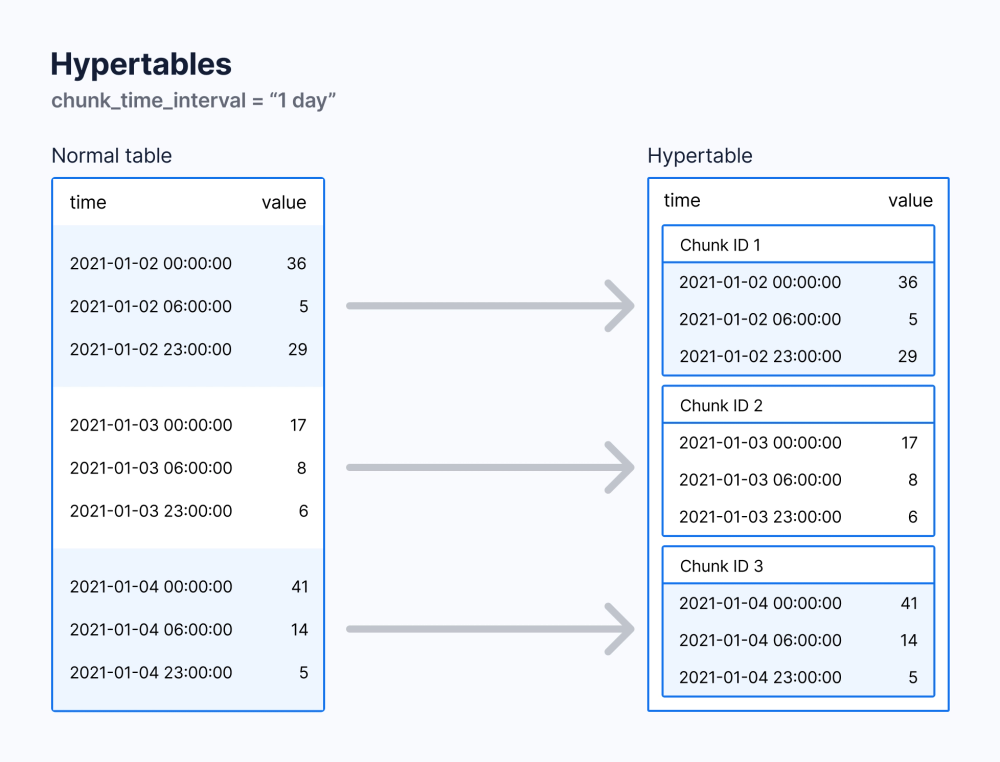
TimescaleDB uses "hypertables" to manage large datasets, automatically partitioning them into "chunks" based on time intervals and - optionally - space. These chunks, essentially smaller tables, store data within specific time frames, facilitating efficient data management.
Timescale's own best practices recommend sizing chunks to balance memory efficiency with query performance, avoiding overly small chunks that can degrade query planning and compression.
A constraint inherited from PostgreSQL is that any unique index or primary key on a hypertable must include the time partitioning column. This is because PostgreSQL can only enforce uniqueness within each partition (chunk) individually. While this doesn't affect tables without unique constraints, it can complicate schema design when global uniqueness is required—often forcing composite keys that include the timestamp.
Furthermore, while Hypercore's columnar compression helps with storage and analytical queries on older data, incoming writes still go through PostgreSQL's row-based format (B-Tree + heap file) before conversion—adding latency compared to databases that write directly to columnar storage.
All told, when compared to Postgres itself, Timescale adds a powerful time series dimension. However, when down in the "deep end" of time series, the core limitations become more clear.
QuestDB architecture
QuestDB is positioned as a high-performance, open-source time series database (TSDB) developed using low-latency (zero-GC) Java, C++, and Rust. It combines the convenience of the InfluxDB Line Protocol with SQL's familiarity, ensuring users enjoy both flexibility and ease when querying and a tried-and-true protocol for high-volume ingestion.
At its core, QuestDB implements a three-tier columnar storage architecture optimized for both high-throughput ingestion and fast analytical queries:
Tier 1 - Write-Ahead Log (WAL): Incoming writes land in a WAL for durability. The WAL buffers and sorts out-of-order data before committing to storage, enabling millions of rows per second without sacrificing data integrity.
Tier 2 - Columnar partitions: Data is organized into time-partitioned columnar files. Each partition stores columns in separate files, enabling efficient compression, selective column reads, and parallel SIMD-accelerated scans.
Tier 3 - Cold storage (Parquet): Older partitions can be converted to Parquet and moved to object storage (S3, Azure Blob, GCS). Queries transparently span all tiers, keeping hot data fast while reducing storage costs.
Tier One: Hot ingest (WAL), durable by default
Incoming data is appended to the write-ahead log (WAL) with ultra-low latency. Writes are made durable before any processing, preserving order and surviving failures without data loss. The WAL is asynchronously shipped to object storage, so new replicas can bootstrap quickly and read the same history.
Tier Two: Real-time SQL on live data
Data is time-ordered and de-duplicated into QuestDB's native, time-partitioned columnar format and becomes immediately queryable. Power real-time analysis with vectorized, multi-core execution, streaming materialized views, and time-series SQL (e.g., ASOF JOIN, SAMPLE BY). The query planner spans tiers seamlessly.
Tier Three: Cold storage, open and queryable
Older data is automatically tiered to object storage in Apache Parquet. Query it in-place through QuestDB or use any tool that reads Parquet. This delivers predictable costs, interoperability with AI/ML tooling, and zero lock-in.
Unlike TimescaleDB's hypertable architecture built on PostgreSQL's row-based storage, QuestDB stores all time series in a single columnar table structure. This means adding new series (high cardinality) doesn't create additional storage overhead—the same columnar files simply contain more rows. This architectural difference explains why QuestDB maintains consistent performance as cardinality scales.
QuestDB is built on open formats—Parquet today, with Iceberg and Arrow on the roadmap—keeping your data portable and free from vendor lock-in. While TimescaleDB ties data to PostgreSQL's storage format, QuestDB still benefits from the PostgreSQL ecosystem via PGWire connectivity.
Both have since shipped, in
QuestDB 10.0 in August 2026. Query results
stream back as Apache Arrow
over QWP, and 10.0 writes Parquet that follows the conventions the Iceberg
ecosystem expects, so the files register into Iceberg with add_files, or into
DuckLake, without a copy. Tiering cold partitions to object storage is a
QuestDB Enterprise 4.0 feature.
In developing QuestDB from the ground up, the team focused on:
-
Performance: Built for high-throughput and high-cardinality workloads. Query speeds are accelerated via SIMD instructions, a custom JIT compiler for parallel filters, and time-partitioned storage.
-
Flexibility: Schema-less ingestion allows dynamic column addition. Concurrent schema changes don't compromise writes.
-
Compatibility: Supports InfluxDB Line Protocol (extended for arrays), PGWire, REST API, CSV, and Parquet import/export. High-performance client libraries available in multiple languages.
-
Enhanced SQL: Time series-specific SQL extensions simplify querying temporal data.
TimescaleDB limitations
Both databases have their strengths and so too, each has its own limitations. We'll start with TimescaleDB.
Temporal JOINs and missing time-based extensions
Timescale does not support joining tables based on the nearest timestamp, also known as ASOF JOIN. These joins are heavily used and relied upon in financial markets.
TimescaleDB also lacks some easy ways to manipulate time series data. For example, retrieving the latest data for a given attribute/channel in the data (such as currency pair or sensor type) involves computing expensive lateral joins.
Check out the difference:
- QuestDB
- PostgreSQL and Timescale
- DuckDB
-- QuestDB provides ASOF JOIN. Since table definition includes-- the designated timestamp column, no time condition is neededSELECT t.*, n.*FROM trades ASOF JOIN news ON (symbol);
Additionally, there are no built-in functions to deal with periodic intervals. Timescale does however offer continuous aggregate views. These views pre-aggregate data into summary tables, optimizing queries that compute statistics over fixed time intervals.
Schema change overhead
Schema adjustments in TimescaleDB, though possible through
ALTER TABLE ADD COLUMN operations, are not without their drawbacks. These
modifications increase in pain with the scale of the database, primarily due to
the extensive re-indexing required by PostgreSQL for both old and new rows.
Ingestion performance
TimescaleDB's performance tuning requires balancing index usage, foreign key constraints, and unique keys—each adds overhead that impacts insert speed. Optimizing for time series workloads demands careful trade-offs between data integrity features and ingestion throughput.
High cardinality data
TimescaleDB's ingestion rate degrades with high-cardinality datasets due to its row-based ingestion and heavy indexing. The recommended mitigation—minimizing indices, foreign keys, and unique keys—runs counter to PostgreSQL's traditional strengths.
PostgreSQL extension
Installing TimescaleDB requires PostgreSQL first, then the extension, then time-series-specific tuning. QuestDB is dependency-free and ready out of the box. Less of an issue on managed cloud platforms, but adds maintenance overhead when self-hosting.
QuestDB limitations
Next, for QuestDB.
Type of workload & use case
TimescaleDB, built on PostgreSQL's row-based architecture, supports OLTP operations (INSERT, UPSERT, UPDATE, DELETE, triggers). QuestDB is columnar and optimized for OLAP and time series workloads—high ingest throughput, fast queries, and time-based analytics common in financial services, IoT, and Ad-Tech.
QuestDB is not designed for OLTP and is less suited for log monitoring use cases.
Weaker PostgreSQL compatibility
QuestDB supports PGWire, enabling use with most PostgreSQL libraries. However, it only supports forward-only cursors—not scrollable cursors via DECLARE CURSOR and FETCH. Some drivers like psycopg2 rely on scrollable cursors and may not be fully compatible.
Ecosystem maturity
Timescale (2016) has a head start over QuestDB (2019), resulting in a wider array of third-party integrations. QuestDB's ecosystem is growing but remains smaller.
 Postgres
 Grafana
 Kafka
Kafka Redpanda
 Python
 Pandas
 Superset
 Spark
Spark Polars
 Telegraf
 MindsDB
 Flink
FlinkClosed source features
Several additional QuestDB features are closed-source under a proprietary license. These include replication, role-based access control, TLS, and compression. This is also true for Timescale.
Conclusion
As with all databases, choosing the "perfect" one depends on your business requirements, data model, and use case.
TimescaleDB is a natural fit for existing PostgreSQL users. However, being built on top of PostgreSQL it inherits row-based limitations that affect time series and analytical workloads. The benchmark results reflect these architectural differences.
QuestDB is less mature as an overall ecosystem. But if performance is of any concern, then it's available as an attractive, developer-friendly database for demanding workloads. The community is active, enthusiastic, and growing rapidly.
Many marketing pages make grand performance claims. But until your prospective database contains your own data and is hosted in your own infrastructure, you just won't know.
To get started, try our live demo, download QuestDB, or explore QuestDB Enterprise for production deployments.
For a single-workload comparison showing how QuestDB's dedicated SQL operators affect performance vs. standard SQL rewrites on TimescaleDB, see How we made WINDOW JOIN parallel and vectorized. This is not a standardized benchmark like TSBS or ClickBench.