Reflexivity switched from InfluxDB to QuestDB


Reflexivity is a SaaS company that uses QuestDB to provide AI-powered investment insights from all data that moves markets.
Reflexivity uses AI and machine learning to help investors extract signals from vast amounts of market data. The platform ingests and processes billions of data points, including prices, fundamentals and sentiment, then distills them into actionable alerts such as "Analyst expectations are turning negative for AAPL; historically this pattern precedes outperformance of the stock."
This workload relies on a continuous stream of time series data that must be stored efficiently and queried quickly by downstream models. Every step of the pipeline needs to be optimised, from ingestion to historical analysis, in order to keep query latency low while controlling infrastructure cost.
Scaling challenges with InfluxDB
Before adopting QuestDB, Reflexivity experimented with several databases, including MongoDB, Cassandra and TimescaleDB. After extensive testing they initially standardised on InfluxDB, which provided the best performance at the time. As the company and data volumes grew, however, the InfluxDB deployment became increasingly expensive and difficult to operate.
The production cluster ran on four m4.2xlarge instances with 128 GiB of RAM. Memory usage across the cluster frequently sat above 80 percent and regularly spiked to 100 percent several times per week. When the team projected infrastructure requirements for future growth, it became clear that InfluxDB would not be a viable option at scale.
Selecting a new time series database
When evaluating alternatives, Reflexivity defined a set of practical questions that any replacement needed to answer positively:
- Can existing data be moved seamlessly and quickly?
- Can the team query a representative sample of data with response times at least as good as InfluxDB?
- Can new data be ingested without disruption?
- Can new time series be created on the fly as needs evolve?
- Can performance be maintained after all historical data has been imported?
Among all the solutions evaluated, QuestDB was the only database that met every one of these criteria while also offering a clear path to lower infrastructure cost.
Side by side performance comparison
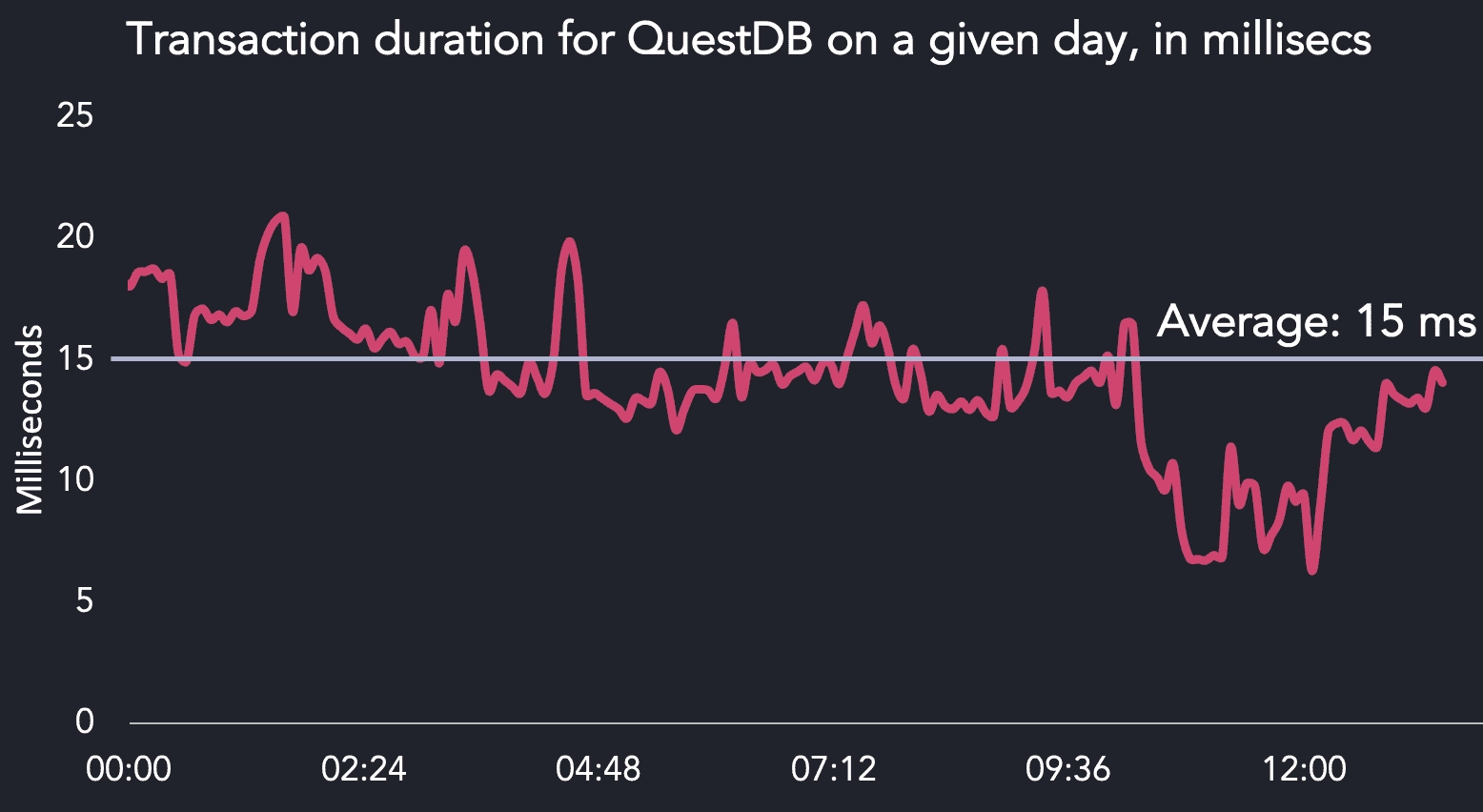
On the original InfluxDB cluster, typical analytical queries averaged more than 5 seconds of response time, even with four m4.2xlarge machines. After a few weeks of running the same workload on QuestDB, now on a single machine, the average response time dropped to roughly 15 milliseconds. This represents more than 30 times faster queries for the same business logic.
At the same time, the virtual machine metrics showed that the QuestDB server was never overtaxed, with CPU utilisation around 17 percent user time and 4 percent system time. This allowed Reflexivity to run the workload on a quarter of the previous number of machines while keeping plenty of headroom for future growth.
- Avg ingested rows/sec
- 3M+
- Write speed vs InfluxDB
- 10x
- Faster queries
- 30x
- Uptime
- 99.9%
The QuestDB team assisted us in all steps along the way. They were proactive in supporting our changeover, helping to debug issues as they arose, and optimize our deployment as we moved things into production.

QuestDB's performance improvements
Migrating from InfluxDB to QuestDB proved straightforward. The team used a simple script to read data from InfluxDB and ingest it into QuestDB, importing more than 600 million data points in a matter of minutes. There was no need for complex ETL tooling or a long parallel run.
With queries now more than 30 times faster, servers running at modest utilisation and the ability to serve the same workload on a quarter of the original machines, Reflexivity achieved both direct cost reduction and a significant performance boost. This freed the team to focus on improving models and features rather than managing infrastructure bottlenecks.